Table of contents
TL;DR / [Geek Summary]:
- Protocol Exploitation: Analyze the 802.11 Deauth management frame flaw to force target devices offline at the physical layer.
- Pentest Chain: Use Kali Linux’s Aircrack-ng suite to execute Monitor mode sniffing and
aireplay-nginterference attacks.- Hardening: Force-enable 802.11w (MFP) or upgrade to WPA3 to natively immunize your network against spoofed management frames.
Disclaimer: This article is for technical education and security awareness purposes only, aimed at helping readers understand wireless network vulnerabilities. Do not use these techniques in unauthorized environments or for illegal purposes. Unauthorized access or interference with networks is a violation of relevant laws and regulations.
In wireless communication, the 802.11 protocol defines management frames to maintain connection status. Among these, the Deauthentication (Deauth) frame is a vital control mechanism. However, due to historical protocol design limitations, it has often been used to analyze security weaknesses. This article provides a technical analysis of how it works and how to secure your personal network.
# 1. What is a Deauthentication Frame?
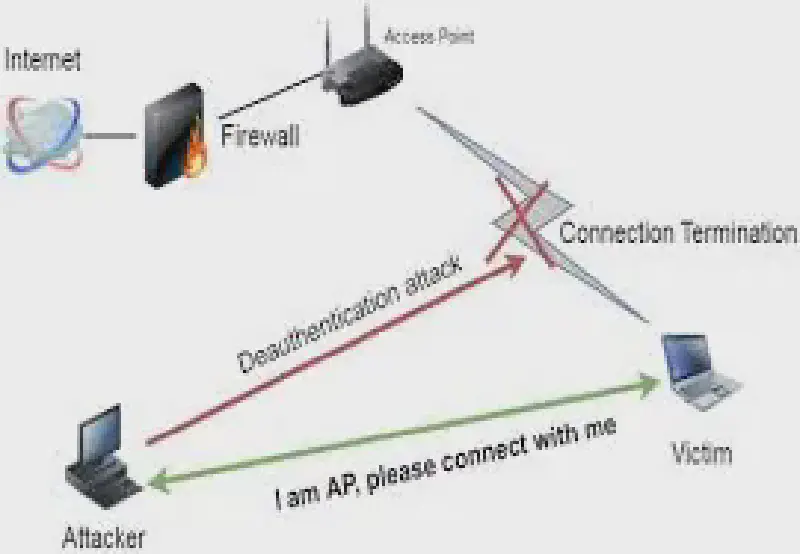
In the Wi-Fi standard, Deauthentication frames are a type of management frame. Their legitimate use is to inform a client or Access Point (AP) that a connection is being terminated (e.g., when a user logs out or an AP needs to reboot for maintenance).
# Security Vulnerability:
Earlier Wi-Fi protocols (such as non-Management Frame Protection versions of 802.11b/g/n) do not require these management frames to be encrypted or authenticated. This means a third-party device can spoof the AP’s MAC address and send a Deauth request to a client, which will trust the request blindly and force a disconnection.
# 2. Protocol Simulation Analysis (In Controlled Environments)
To understand defensive mechanisms, researchers often use the Aircrack-ng suite in controlled environments (such as Kali Linux) to observe this process.
# Lab Preparation:
- A wireless network card capable of Monitor Mode.
- An isolated experimental network with controlled test devices.
# Reconstruction Steps:
Enter Monitor Mode: Enable the wireless card to capture ambient wireless packets.
1sudo airmon-ng start wlan0Identify Target and Channel: Observe the operating channel and BSSID (MAC address) of the test AP.
1sudo airodump-ng wlan0monObserve Data Interaction: By sending simulated Deauthentication frames, researchers can observe how clients respond to disconnections and subsequent reconnection attempts (the Handshake process).
1
2
# Example command: Sending test frames to trigger disconnection logic sudo aireplay-ng --deauth 5 -a <AP_BSSID> -c <CLIENT_MAC> wlan0mon
# Experimental Log Reference:
After sending the test frames, the client will disconnect immediately. Researchers can then analyze WPA/WPA2 handshake packets to evaluate encryption strength.
# 3. Common Defenses and Hardening Recommendations
To mitigate risks associated with Deauthentication vulnerabilities, users and administrators can implement the following:
# A. Enable 802.11w (Management Frame Protection - MFP)
This is the most effective defense. The 802.11w protocol encrypts management frames, ensuring that spoofed disconnection frames fail validation.
- Recommendation: Set Management Frame Protection to “Required” or “Capable” in your router settings.
# B. Upgrade to WPA3
The WPA3 encryption protocol mandates Management Frame Protection. If your devices support WPA3, enable it to gain native immunity to protocol-level interference of this kind.
# C. Monitor for Attacks
Use Wireless Intrusion Detection Systems (WIDS) to monitor for high volumes of Deauth frames within short intervals.
# D. Physical Layer Defense
Reduce wireless signal leakage (by lowering transmit power or using directional antennas) to shrink the physical range available to potential interlopers.
# Conclusion
The Deauthentication mechanism is an essential part of wireless protocols, but it serves as a reminder that protocol security must evolve. Understanding these principles is not about exploiting vulnerabilities, but about better configuring our network environments to ensure robust and secure connectivity in an increasingly complex digital space.
Learning Suggestion: We recommend studying the IEEE 802.11 standard documentation and regional cybersecurity laws to enhance your technical expertise within legal boundaries.